Availability: Vence has been deployed in a select few locations in Australia and is not available for sale in New Zealand. Reach out if you'd like to discuss your specific operation.
eShepherd (built by Gallagher) and Vence (owned by Merck Animal Health) are two of the most established virtual fencing systems running on commercial cattle operations in the United States and Canada. They take very different approaches to almost every part of the system: hardware ownership, battery technology, connectivity, app design, and ecosystem.
This article walks through them head to head and gives you the honest read on which fits which operation.
The headline differences
| eShepherd | Vence | |
|---|---|---|
| Built by | Gallagher (livestock since 1938) | Merck Animal Health |
| Pricing model | Buy hardware, low monthly fee | Lease only, no ownership option |
| Battery | LiFePO4 solar, 7 to 10 years | Single-use, replaceable, 2 to 12 months |
| Connectivity | Cellular and LoRa, mix on one property | LoRa base station only |
| Containment | 99% | 80 to 95% |
| Apps | Full mobile and web | Web only (mobile view-only) |
| Pasture monitoring | Yes, with auto-calibration | No |
| Animal weighing | Yes (Gallagher integration) | No |
| Min order | 20 head | None |
| Countries | 14+ | US, plus select deployments in AU. Not in NZ or CA |
Cost over time
The University of Arizona Cooperative Extension and the Rangelands journal both ran independent total cost of ownership analyses across virtual fencing systems. Per cow on a base-station setup:
| Over 5 years | Over 10 years | |
|---|---|---|
| eShepherd | $440 | $530 |
| Vence | $550 | $850 |
That works out to eShepherd being about 38% cheaper per cow per year on a 10-year horizon ($53/cow/year vs $85/cow/year).
The reason: Vence collars use a single-use battery that lasts anywhere from 2 to 12 months depending on use, with a $10 replacement cost each time and labour to swap. Over a decade of operation, those costs add up. eShepherd's solar-powered LiFePO4 collar runs for 7 to 10 years on the same battery.
Battery and power
This is the biggest single difference between the systems.
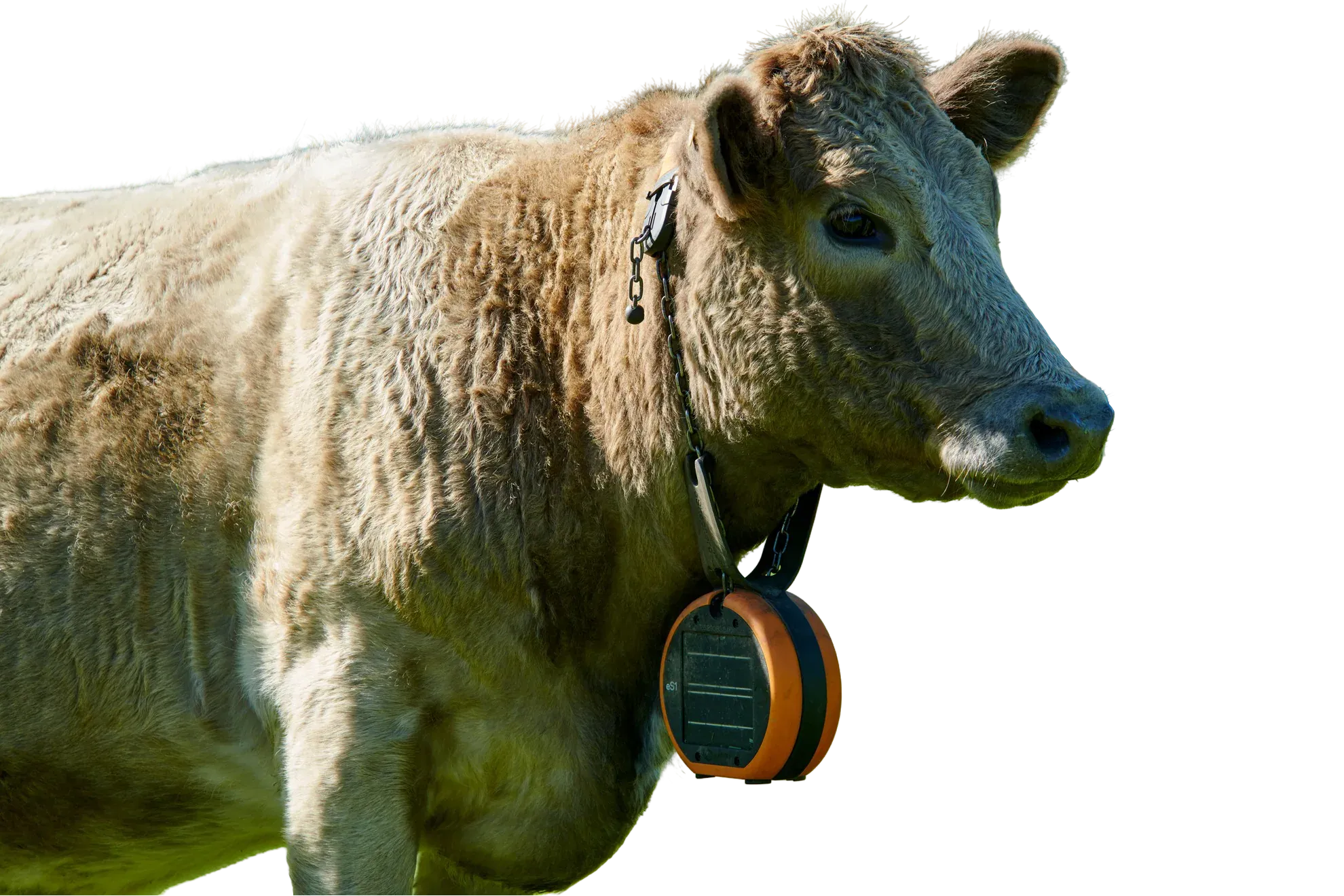
eShepherd uses a lithium iron phosphate (LiFePO4) battery paired with a solar panel on top of the collar. Designed life is 7 to 10 years with a 3-year warranty. Solar keeps it topped up under normal grazing. The battery doesn't get swapped during the working life of the collar.
Vence has no solar panel. The battery is single-use and replaceable. Depending on how often the animal interacts with the boundary, it lasts anywhere from 2 to 12 months. To swap a battery, you take the collar off the animal, undo a screw door, disconnect wires, fit the new battery, reassemble, and put it back on. That happens repeatedly across the working life of the collar.
If you're running 200 head on Vence, you might be doing 200 to 1,200 battery swaps a year depending on how the collars are used. Each swap costs the battery (around $10) plus the labour to handle the animal and do the work. Over 10 years, that's a significant operating cost most year-one TCO calculations miss.
eShepherd is also the only system using LiFePO4 chemistry, which has no cobalt or nickel, lasts roughly twice as many cycles as standard lithium-ion, and is far more thermally stable.
Connectivity
eShepherd sells the same neckband in two flavours. A cellular version that connects to local mobile networks via a global SIM that roams across all major carriers (Verizon, AT&T, T-Mobile, US Cellular and others), and a LoRa version that talks to a base station. You can mix both on one property under one platform.
Vence is base-station-only. Each base reaches up to
eShepherd's LoRa base station is around US$5,000 (regional pricing varies — get a quote for your operation), and you only need one when cellular won't work.
Containment
This is the most important number in any virtual fencing system. How often do the animals stay inside the boundary you set?
eShepherd: 99% Vence: 80 to 95%
That gap matters in practice. On 100 head, the difference between 99% and 90% containment is the difference between one animal escaping and ten. For operations near roads, sensitive habitat, neighbours, or any place where escapes have real consequences, a 4 to 19 percentage point gap is not academic.
eShepherd also has features that compound this. Return to Paddock automatically tries to bring an escaped animal back before the system gives up on it. Bad Paddock Alerts warn you if a virtual paddock you've drawn has no water access or has corners too tight to be safe. Exclusion zones let you draw a no-go area around a barn, house, or hazard. None of these features exist in Vence.
Apps
eShepherd has had both a fully featured mobile and web app since commercial sales started in 2022. You can do effectively everything from either one. Heat maps go back 30 days at a time, anywhere within the last 6 months. Tracks let you see where an individual animal has been over the past 7 days, useful for finding new calves or working out why a mob is doing what it's doing.
Vence is the opposite: web only, with a view-only mobile companion. You can see where animals are on your phone, but every actual change to the system happens at a desk. For a
Pasture monitoring and weighing
eShepherd offers pasture monitoring built into the platform. Satellite multispectral imagery, automatically calibrated by patented ground sensors. No pasture walks. No plate meter. End-to-end automatic.
eShepherd also integrates with Gallagher Vision Weigh for automatic in-paddock weighing, with weights coming into the eShepherd platform.
Vence doesn't offer either. The company is owned by Merck, which has SenseHub for animal health (heat detection, pregnancy detection), but Merck has confirmed there are no plans to integrate Vence with SenseHub. Vence is a virtual fencing system and nothing else.
Where Vence fits
Vence is built for very large extensive Western
If your operation looks like that and ownership of hardware isn't important, Vence has track record on the size of country it's designed for.
For everyone else, including most cow-calf, stocker, and rotational grazing operations, eShepherd is the stronger system across cost, containment, battery longevity, app experience, and ecosystem breadth.
What to do next
Get an indicative quote for your operation →
Want to hear from
Coming to a field day, demo or industry event near you? See where we'll be →
Read the broader four-system comparison: How eShepherd compares to other virtual fencing solutions.
This article reflects publicly available information on Vence as of May 2026. Pricing and specifications change. Cost figures are drawn from the Rangelands journal paper "The economic fundamentals of virtual fencing compared to traditional fencing" (Boyer et al., 2025) and the University of Arizona Cooperative Extension virtual fencing comparison.